Deafness Is Not the Barrier—Society Is
Public perception of deafness is deeply flawed, fueled by myths that hinder effective communication and inclusion. Despite diversity in communication methods, the notion that deaf individuals cannot speak is a harmful stereotype. Technology has advanced accessibility, but systemic barriers remain. Recognizing the cultural and linguistic heritage of the Deaf community is essential for respect and recognition.
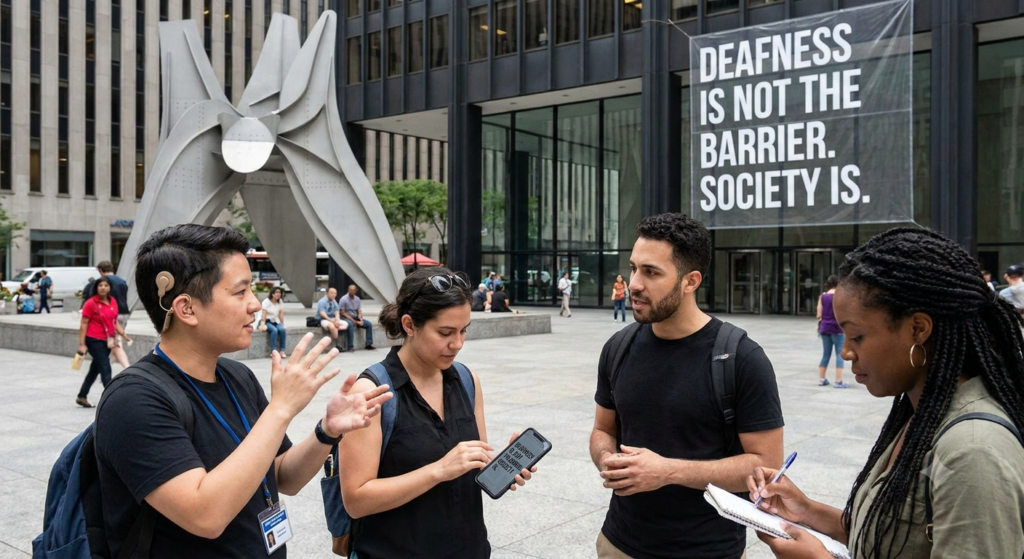

Public perception of deafness remains deeply shaped by myths, and those misconceptions continue to do real harm. For many deaf individuals, the greatest challenge is not the absence of hearing, but the presence of barriers created by society’s lack of understanding and inclusion.
It is time to confront these assumptions directly.
Not all deaf people communicate in the same way, yet society often treats them as a single, uniform group. While some use sign language, others rely on speech, lip-reading, writing, or assistive technologies. Communication is not one-size-fits-all, and expecting it to be only reinforces exclusion.
Equally misleading is the belief that deaf individuals cannot speak. Many can and do. Others choose not to, and that choice should be respected rather than questioned. Communication is about effectiveness, not conformity.
Popular culture has also exaggerated the ease of lip-reading. In reality, even the most skilled lip-readers can only understand fragments of a conversation. When people assume otherwise, they place unfair responsibility on deaf individuals instead of improving communication practices.
Another damaging myth is that deafness limits potential. This is simply untrue. Deaf individuals are professionals, entrepreneurs, leaders, and public servants. They contribute meaningfully across all sectors of society. The issue is not ability—it is access.
For many within the Deaf community, deafness is not a condition to be “fixed,” but an identity to be respected. The capitalized “Deaf” reflects a rich cultural and linguistic heritage that deserves recognition, not erasure.
Yet, everyday interactions still reveal a lack of awareness. Speaking louder does not improve communication. What works is simple respect: facing the person, speaking clearly, and adapting to their preferred method of interaction.
Understanding deafness also requires recognizing its diversity. Hearing loss exists on a spectrum, and no two experiences are exactly alike. Policies and attitudes must reflect this reality rather than rely on narrow assumptions.
Encouragingly, technology has opened new doors. From captioning services to video communication and assistive devices, digital innovation has improved accessibility. But technology alone cannot dismantle systemic barriers.
The deeper issue lies in how society is structured. When public spaces, services, and information are not designed with accessibility in mind, deaf individuals are excluded by default. Inclusion should not be an afterthought—it should be a standard.
At its core, this is a matter of equity. Deaf people have the same dreams, talents, and ambitions as anyone else. What they require is not pity, but opportunity. Not sympathy, but respect. Not assumptions, but understanding.
If we are serious about building inclusive communities, then we must move beyond awareness and toward action. That means listening to deaf voices, investing in accessibility, and challenging the biases that persist in everyday life.
Deafness is not the barrier. Society is. And that is something we have the power—and the responsibility—to change.